
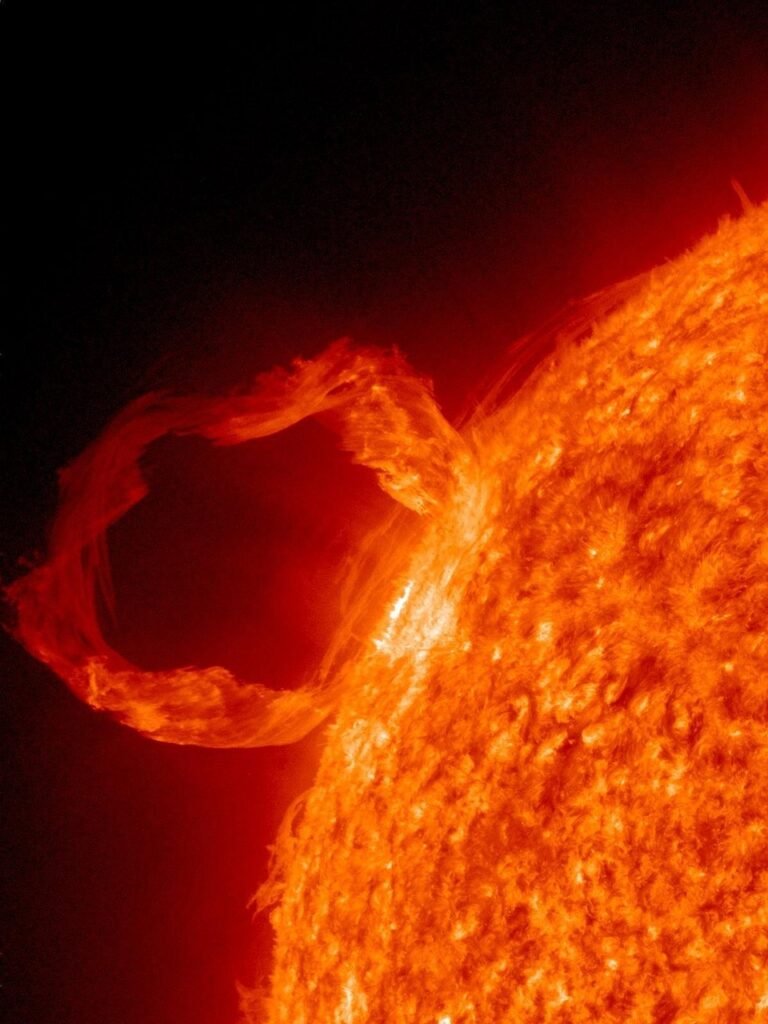
A solar flare powerful enough today to rival the 1859 solar flare named the “Carrington Event” could disrupt power grids, satellites, communications, and critical infrastructure worldwide and lead to large scale disaster for humankind due to today’s dependency on electricity — just a powerful reminder that space weather can threaten modern civilization at any time.
Prepare With Us, Prepare with Knowledge
Part of the reason Arise 4 Freedoms will be providing needed survival items is to help humanity and especially our Arise 4 Freedoms family to weather any storm. Humanity has always looked to the Sun for warmth, life, and light. But on rare occasions, the Sun reminds us that it is not just a gentle star — it is a cosmic engine capable of unleashing storms so powerful they can shake the foundations of our technological world. One such reminder came in 1859, during what is now known as the Carrington Event, the most intense geomagnetic storm ever recorded. (See Wikipedia)
Today, with our dependence on electricity, satellites, and digital infrastructure, scientists warn that a similar event could bring modern civilization to a sudden halt.
The Day the Sun Struck Earth
On September 1, 1859, English astronomer Richard Carrington observed a sudden flash of white light erupting from a cluster of sunspots — the first recorded observation of a solar flare. All That’s Interesting
Within 17.6 hours, a massive coronal mass ejection (CME) slammed into Earth’s magnetic field, an arrival so fast that scientists believe a previous CME had “cleared the way” for it. (Wikipedia)
What followed was chaos.
- Auroras lit the skies from the Rocky Mountains to Panama, bright enough that people claimed they could read newspapers at night. All That’s Interesting
- Telegraph systems — the backbone of global communication at the time — sparked, shocked operators, and even caught fire. Some telegraphs sent messages without being plugged in, powered only by the storm’s induced currents. National Oceanic and Atmospheric Administration
- Many newspapers in southern states in America reported the night auras to be so bright they could read a book. Some thought it was the second coming of Jesus Christ.
It was a breathtaking display of nature’s power — and a warning.
What If It Happened Today?
In 1859, the world had no satellites, no GPS, no power grid, no internet. Yet the storm still caused fires and global communication failures.
Today, the consequences would be far more severe.
According to NOAA and USGS research:
- Solar flares and CMEs can disrupt GPS, jam radio communications, and damage satellites. National Oceanic and Atmospheric Administration
- A Carrington‑scale storm could cause widespread blackouts across the U.S., especially in the Midwest and East Coast, where the grid is most vulnerable. (USGS.gov)
- Modern geomagnetic storms have already caused radio blackouts, satellite delays, and auroras as far south as Alabama and Florida — and these were minor compared to 1859. (USGS.gov)
- One report for the U.S. congress claimed as many as 90% of American lives could be in danger because of the lack of electricity that could take years to fully restore.
The 1859 storm was so powerful that it circled the Earth’s magnetic field like a bell struck by a hammer. If such a blow landed today, experts warn it could:
- Disable power transformers
- Knock out internet backbone infrastructure
- Ground aircraft
- Disrupt emergency services
- Cripple financial systems
- Shut down water and fuel distribution
- Stop the food chain that feeds America and the World
- Stop production of needed medications and supplies
In short: a solar flare could stop humanity — not by destroying cities, but by disabling the systems that keep civilization running.
The Sun Is Becoming More Active
Solar activity follows an 11‑year cycle, with peaks known as solar maximum. Scientists note that we are currently in an active phase, increasing the likelihood of strong solar storms. All That’s Interesting
A very large solar flare barely missed the world in 2025. Recent events — including storms in 2024, 2025, and 2026 — have already caused:
- Radio blackouts
- Satellite delays
- Widespread auroras
- Disruptions to navigation systems (USGS.gov)
These are reminders that the Sun is restless — and capable of far more.
Can We Protect Ourselves?
Scientists and agencies like NOAA and USGS monitor the Sun constantly, but even with early warning, Earth cannot stop a CME. At best, we can:
- Harden the power grid
- Protect satellites
- Build redundancy into communication systems
- Prepare emergency protocols
But the truth remains: our modern world is more vulnerable than ever.
A Story Still Being Written
The Carrington Event was not the first solar superstorm — and it will not be the last. It stands as a historical marker, a cosmic message written in auroras and fire:
The Sun gives life.
The Sun can also take our world offline.
Humanity’s challenge is not to fear the Sun, but to respect it — and prepare with us for the day when it sends another reminder of its power.